Dedicated to sustainable,
high performance building

HSBC BANK PLACE REVITALIZATION

Deep green retrofit demonstrates a ‘smart’ model for scalable energy and carbon reductions

By Charles Marshall, Gerry Doering,  Bahaa Al Neama, DIALOG

Deep green retrofits represent a critical component of the building industry’s response to climate change.  Mobilization across the public and private sectors is necessary to meet national targets for carbon reduction. This project represents a visionary and scalable model for how private buildings can be retrofitted to save energy, reduce carbon, and increase community wellbeing through healthy building strategies and public realm enhancements.

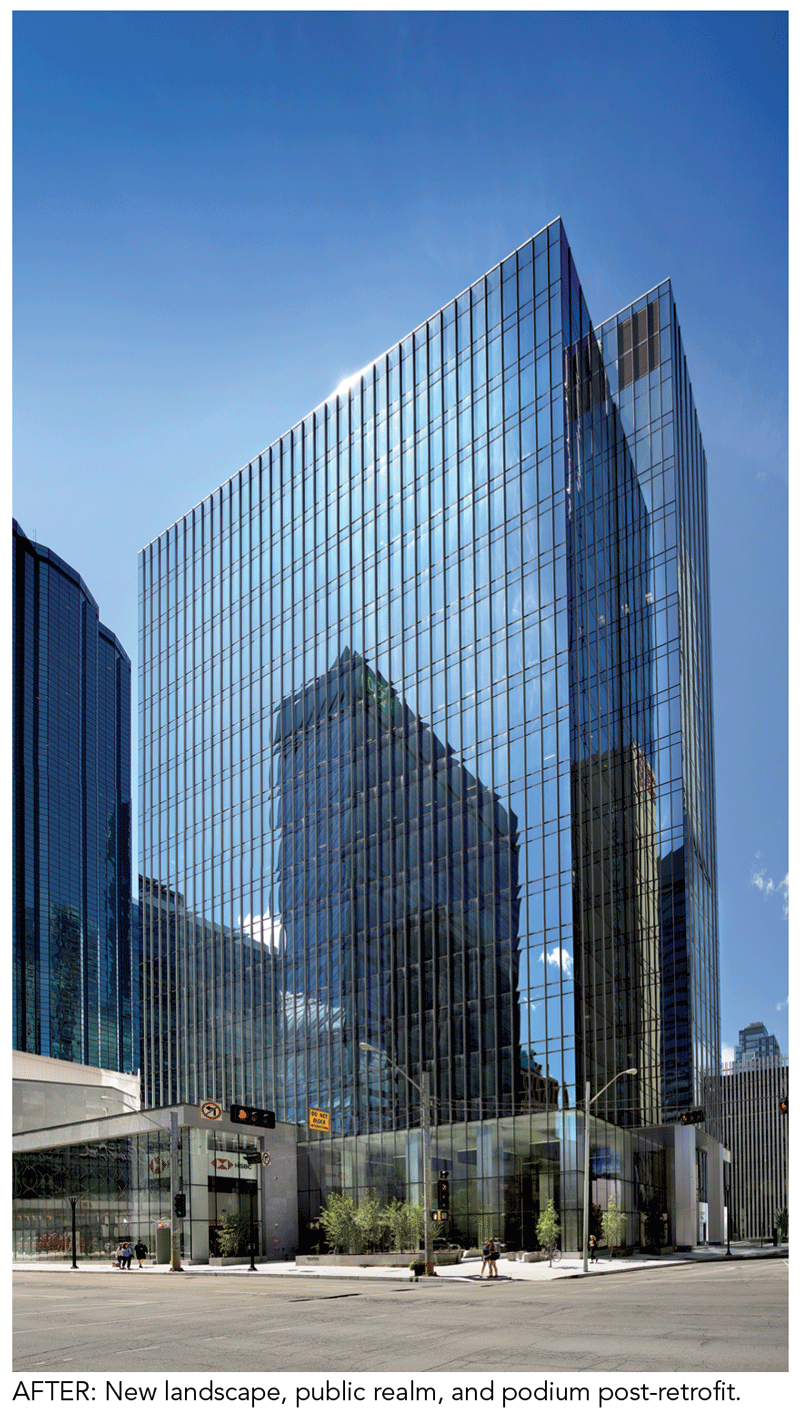
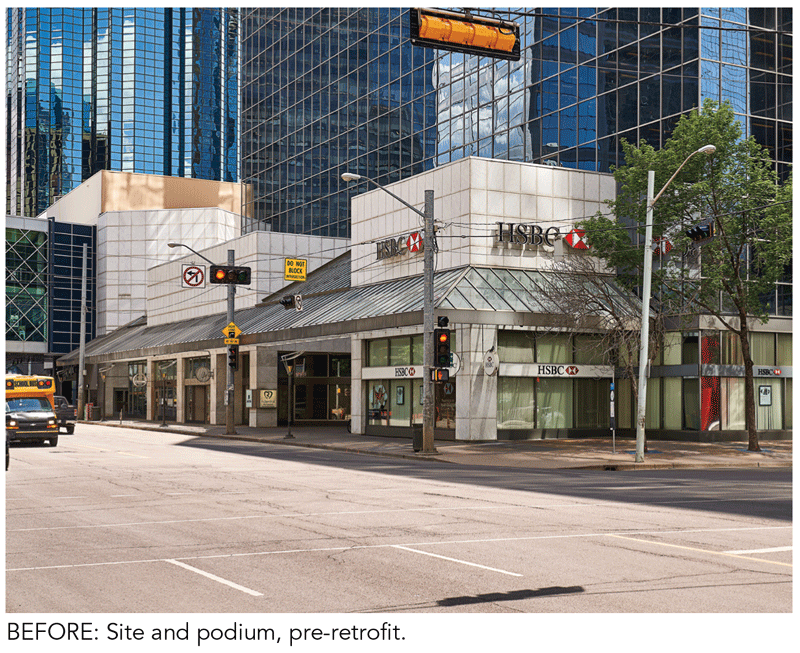
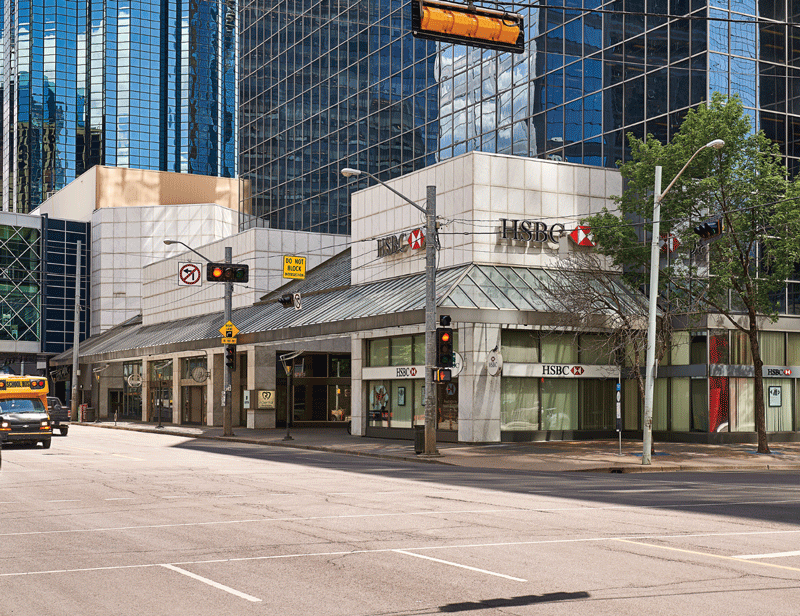
HSBC Bank Place occupies a prominent corner in downtown Edmonton at 103rd Avenue and 101st Street. The building was originally constructed in 1980. By 2017, although the tower still demonstrated some excellent qualities, including excellent urban connectivity and a structure that was built to last, the property was ready for re-investment. 

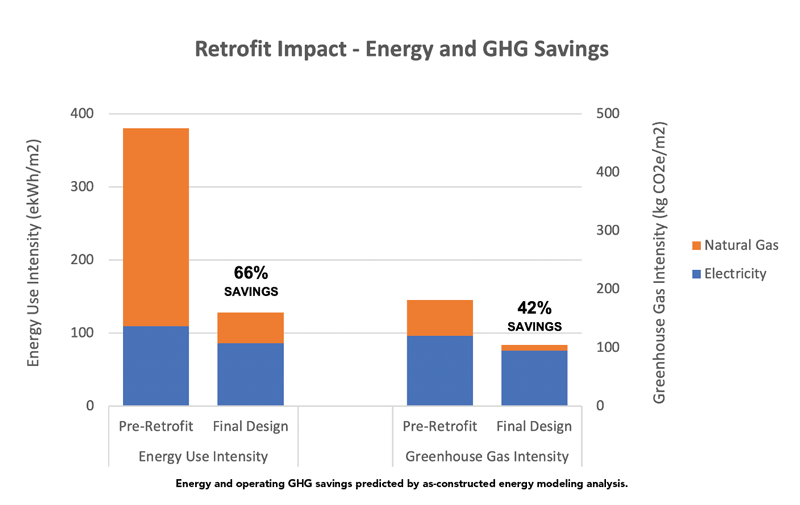
During the initial planning and investigation phases, it was determined that the property was a great candidate for a revitalization and deep green retrofit. Integrated workshops and collaboration between owner, developer, contractor and the design team revealed that an ambitious project scope including re-cladding, replacement of major building systems, and the integration of ‘smart’ building controls could save substantial energy and carbon while materially increasing the property’s attractiveness to tenants.

Across Canada and globally, the need to rapidly reduce GHG emissions creates a strong imperative to decarbonize the buildings sector.  This project provides a unique and inspirational model for how this can be accomplished in a commercial context, demonstrating that there is a business case for healthy, low-carbon, and intelligent ‘smart’ buildings.   

RETROFIT STRATEGIES

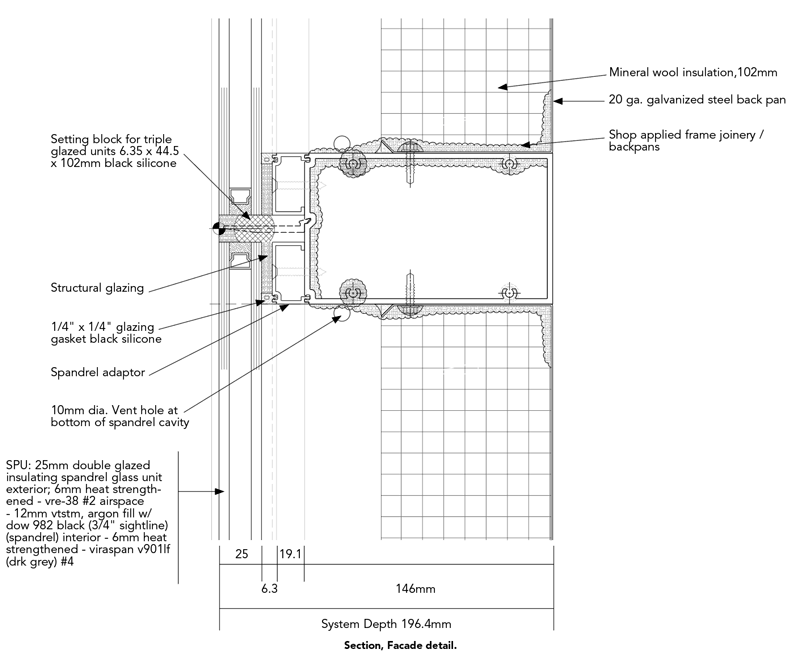
The revitalization project included a complete re-cladding of the tower with the installation of a new, thermally broken triple-glazed curtainwall system and associated upgrades to other building envelope sections.  This envelope replacement dramatically improved thermal insulation values, reduced air leakage, increased occupant comfort, and reduced heating and cooling loads.

HVAC systems were completely replaced, with an old inefficient overhead VAV system giving way to a new dedicated outdoor air system connected to local fan coil units with demand-controlled ventilation.  Lighting was replaced with new high-efficiency, all-LED fixtures connected to advanced controls for occupancy and daylight modulation.

Technology also plays an important part in the strategy for repositioning, revitalization, and targeting of deep reductions in energy, GHG, and utility expenditure.  Systems that are typically separated, including HVAC, lighting, access control, building management, intercom, and video, were connected to an integrated backbone and delivered as one single solution. The result is a highly intelligent building with smart systems for security, communications, tenant experience, and energy tracking. Tenants can access amenities such as parking and the wellness centre using only their cell phones.  In 2020, the project was awarded a WiredScore Platinum certification. 

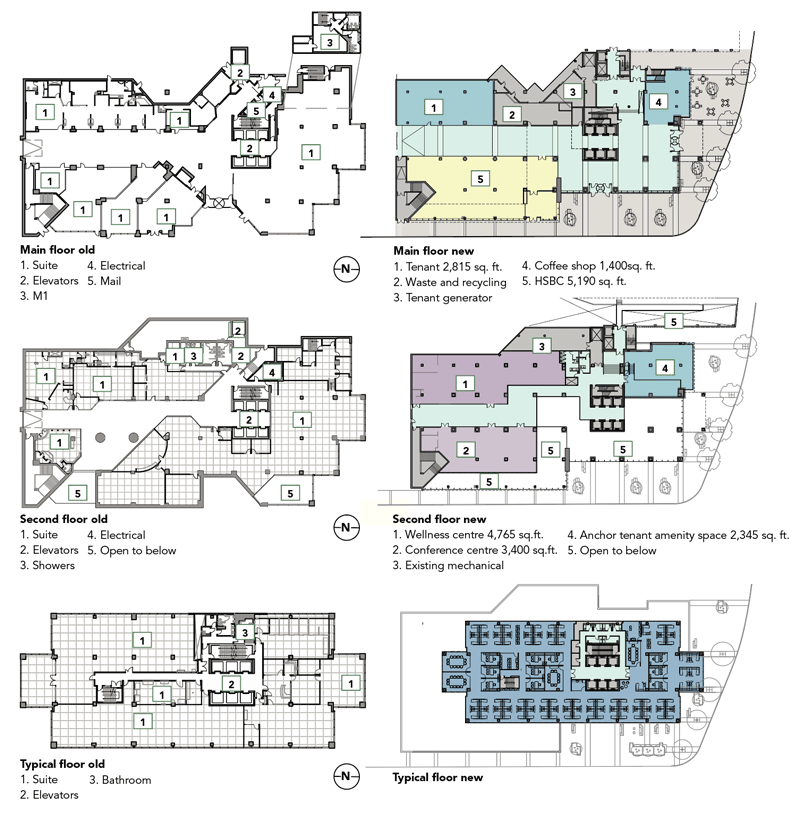
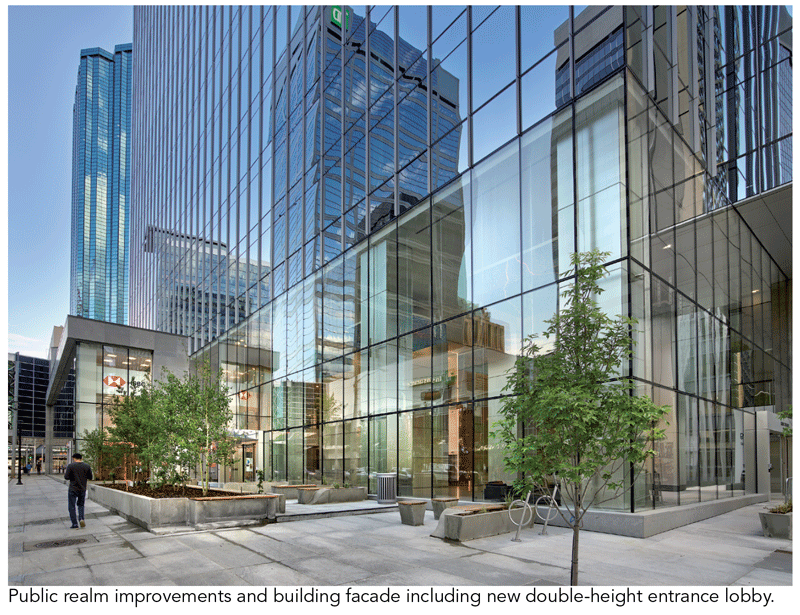
The project scope also included a renewal of the streetscape and landscaping, replacing the aged exterior and minimal public realm with planters, furniture, and space dedicated to socialization and relaxation. The specific context, opportunities, options, and outcomes for the project were evaluated through a lens of community wellbeing, seeking goals and measures that could provide impact outside of the project site area and contribute to the rejuvenation of the downtown.

The result is a property that is completely revitalized and repositioned in the local marketplace. Higher ceilings, more daylight, improved temperature control, and better ventilation air quality contribute to a healthier work environment and position the property to compete with new, modern office towers in downtown Edmonton. 

Project Team

  • Owner  Alberta Investment Management Corporation (AIMCo)
  • Asset Manager and Property Manager  Epic Investment Services
  • Development Management  Cushman Wakefield Asset Services
  • Architect, Interior Designer, Landscape Architect, Sustainability Consulting, Building Performance Analysis  DIALOG
  • General Contractor PCL Construction Management Inc.
  • Structural Engineering  RJC Engineers
  • Mechanical & Electrical Engineering  Smith + Andersen
  • Commissioning & Building Envelope  Morrison Hershfield

SUBSCRIBE TO THE DIGITAL OR PRINT ISSUE OF SABMAGAZINE FOR THE FULL VERSION OF THIS ARTICLE.

Interview with Sam McDermott of Enbridge Gas

Sam McDermott M.Eng., P.Eng., Technical Manager – Renewable Hydrogen, is part of the Business Development team at Enbridge Gas Inc., helping in the development of its hydrogen framework which includes delivery of a blend of hydrogen and natural gas to reduce the carbon footprint of natural gas.

1. Just to get to the basics, what makes hydrogen a clean energy alternative?

It comes down to how it’s made. Power-to-Gas (PtG) is a process in which electrical energy is converted to hydrogen through the electrolysis or splitting of water (H2O) into its basic components of hydrogen and oxygen. If only renewable sources of electricity are used, the hydrogen produced is called renewable. If hydrogen is produced from a mix of renewables and/ or other sources with a high percentage of the carbon captured (greater than 90 or 95 percent), it’s considered low carbon, or termed blue hydrogen. Most of today’s hydrogen is created using steam methane reforming (SMR), a process that separates the hydrogen molecule fom the carbon molecule of methane (CH4). The industry is vigorously working on ways to achieve carbon capture rates greater than 90 and 95 percent.

2. What are the advantages of hydrogen fuel?

Hydrogen is a non carbon energy carrier and produces no green house gasses. If used in a fuel cell, the only by-product is water. It is a versatile energy carrier like electricity. Hydrogen can be used to store electricity, and it can be turned back into electricity. Hydrogen is also used in a myriad of applications such as fertilizer manufacturing, food processing, methanol production, electronics manufacturing and transportation.

3. How much hydrogen can be blended with natural gas to make it a practical energy source?

It depends on factors such as infrastructure vintage, the type of pipe and fittings used, the end use applications, and the policies in place to enable its acceptance, all of which affect blend percentages. You may hear of a blend of 18% or 20% for existing pipes, but the fact remains each gas system is different and must be evaluated on its own merits.

4. How is Enbridge getting into hydrogen production?

In 2018, Enbridge, with project partner Cummins Inc., (formerly Hydrogenics) opened North America’s first utility-scale PtG facility in Markham, Ontario. It converts electrical energy into hydrogen and was primarily used to help the IESO balance the electrical grid during system demand fluctuations. As of 2021, some of the hydrogen from the plant is being blended into the natural gas system as a pilot project to understand the efficacy of reducing carbon in the gas grid. The pilot will run for five years to provide 3,600 customers in the Markham area and insight into blending.

Also, Enbridge subsidiary Gazifere announced in February, with project partner Evolugen (a Brookfield company), plans to operate a 20-MW electrolyzer plant in Gatineau, QC by 2025. Serving about 40,000 customers, the plant will produce renewable hydrogen with the intent of injecting this hydrogen into Gazifere’s natural gas distribution network.

5. What are the next steps to move to a scaled-up use of hydrogen?

As identified in the Canadian Hydrogen Strategy, one of the main elements for the adaptation of hydrogen is de-risking of early developments via incentives such as a price on carbon, seed funding and the rapid development of harmonized codes and standards for the industry in Ontario, in Canada and the world. There is also an urgent need to have enabling policies to drive demand and bring down the cost through scale and innovation. Training and public education through awareness campaigns are vital enablers to move the industry forward and enable public acceptance. Society wants to change its energy reliance but paying for it generates pause. Unlike wind and solar, which took 20 years to realize the price points we see and enjoy today, climate change will not wait.

The City of Vancouver net zero carbon initiative

By Patrick Enright

The City of Vancouver’s initiative to

monitor, regulate and ultimately codify the embodied carbon requirements for buildings is the first of its kind in Canada and provides an example for other authorities, whether municipal, provincial or federal, to follow.

The City of Vancouver’s interest in monitoring embodied carbon in new buildings dates back to 2016. As work was being done on the original Zero Emissions Buildings Plan (designed to bring operational emissions for all rezoning projects to near zero levels) it was pointed out that embodied carbon would then become by far the most important (if not the only) consideration in terms of life cycle carbon for new buildings.

This realization highlighted the need for City staff to develop a better understanding of embodied carbon, and its contribution to overall life cycle carbon emissions. To get started on understanding embodied carbon, a requirement to calculate and report embodied carbon was included with the new rezoning policy that went into effect in 2017. This laid the foundation for a more comprehensive approach to be introduced in the future.

In January 2019, the City of Vancouver declared a climate emergency (joining a global movement that now includes nearly 2300 municipalities worldwide) and commissioned a Climate Emergency Response report to guide future policy decisions. Approved by City Council in April 2019, this report set a target of a 50% reduction in carbon pollution in Vancouver by 2,300 and carbon neutrality by 2050; accelerating the City’s previous climate efforts.1

It also added six major new objectives (referred to as Big Moves) for the next decade. One of the big moves identified in the subsequent Climate Emergency Action Plan (CEAP) was the phased introduction of embodied carbon standards for new buildings. This document enabled City staff to review the rezoning requirement and advise on process, enforcement, and outcomes. It also provided a better understanding of leading-edge practice for embodied carbon calculations, life cycle assessment protocols and related policies.

The data acquired through this reporting phase of the project enabled City staff to determine a realistic baseline against which future mandated embodied carbon reductions could be measured. The methodology for calculating embodied carbon was based on a standard LCA and a building service life of 60 years, with reporting covering the extraction, processing and fabrication of materials and products, construction, operating and deconstruction and disposal phases.

The Embodied Carbon Strategy lays out a 10-year road map; and is designed to achieve the City’s goal of a 40% reduction in the embodied carbon of new buildings by 2030. In May 2022, the City took major action under the CEAP, proposing regulatory changes to the Vancouver Building Bylaw. The first change is to require embodied carbon reporting for all Part 3 buildings starting in July 2023; the next step (approved in principle) is scheduled for implementation in January 2025, when project proponents will have to start demonstrating reductions in embodied carbon below the benchmark levels. The advance notice will provide them with an adjustment period in which to familiarize themselves with the new requirements. 

The implementation of embodied carbon reductions will be a staged process: the first stage will require reductions of 10% for most buildings (including buildings up to 12 storeys constructed under the Encapsulated Mass Timber Construction (EMTC) code adopted by British Columbia and the City of Vancouver in 2020.). For buildings that are of 1-6 storeys, and permitted outright to be of wood frame or mass timber construction, the required reduction will be 20%.

Both the new legislation and the underlying strategy are ‘material neutral’. Proponents will be required to complete the life cycle assessment and submit the results. Establishing a reasonable benchmark at the outset is critical to the success of the program, so the initial benchmark for high-rise buildings is based on concrete construction. This ‘initial benchmark’ will be a baseline that teams create for each project based on their proposed building (as they do currently for LEED projects). Guidance on how to create a baseline will be published as part of the upcoming City of Vancouver Embodied Carbon Guidelines, to be finalized and published in January 2023.

Patrick Enright, P.Eng., is Senior Green Building Engineer with the Sustainability Group at the City of Vancouver.

SUBSCRIBE TO THE DIGITAL OR PRINT ISSUE OF SABMAGAZINE FOR THE FULL VERSION OF THIS ARTICLE.
8X On The Park

LEED Gold tower makes rigorous commitment to detail

By GBL Architects

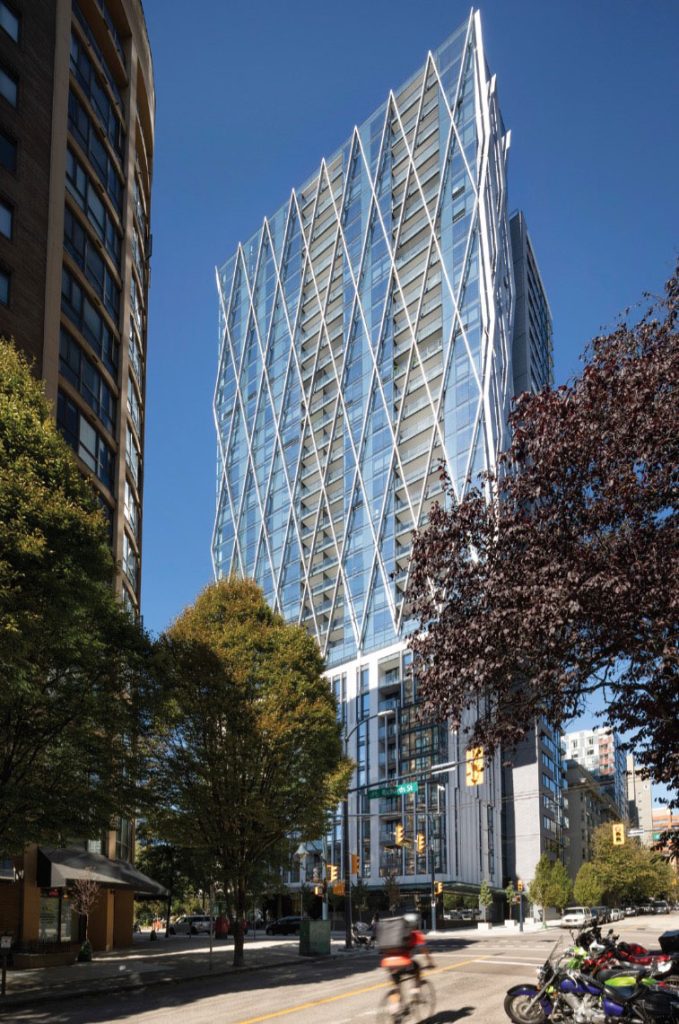
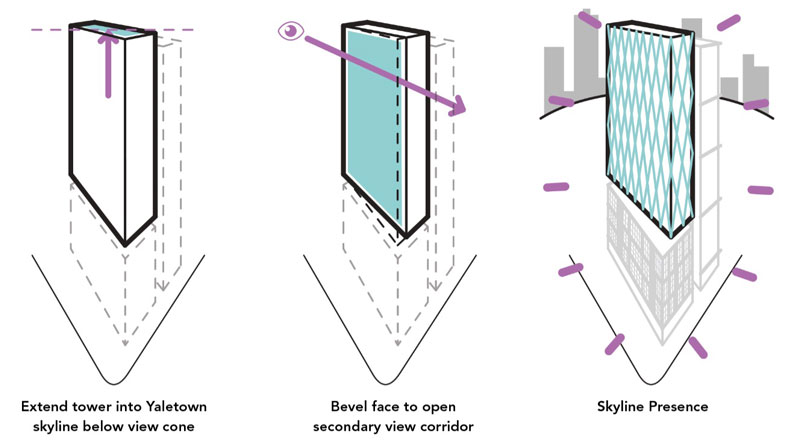
Amid the many ubiquitous residential towers of downtown Vancouver, 8X On The Park stands out for its nuanced, contextual response to the varied urban context and its attention to detail.  GBL Architects guided the project through a complex, decade-long planning and design process that culminated in a 35-storey mixed-use tower of striking presence on the Vancouver skyline.

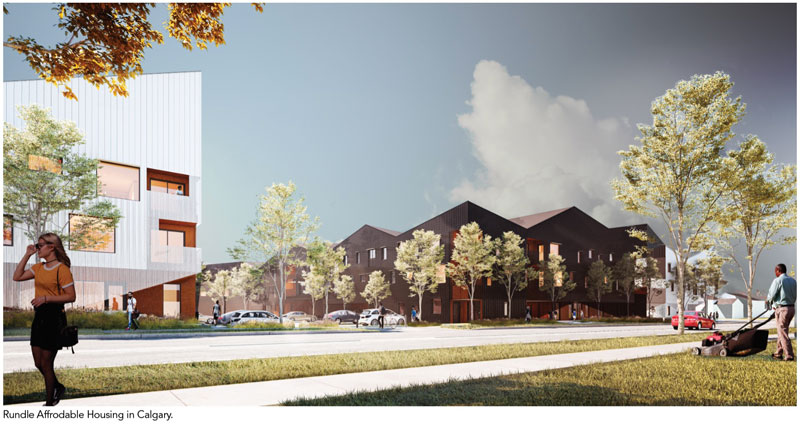
8X On The Park sits at the corner of Richards and Helmcken Street in Vancouver’s upscale Yaletown district, along the northern edge of Emery Barnes Park. Transformation of this intersection began on the northwest corner 10 years ago, with Jubilee House, an affordable housing project, also involving a collaboration between GBL and Brenhill.

Together, the two projects represent a substantial contribution to the neighbourhood of market, rental, and affordable housing units.

The site addresses multiple contextual adjacencies. A neighbouring heritage apartment establishes an urban scale and visual cadence along Helmcken Street to the west. To the east and travelling north and south along Richards Street, multiple towers of varying heights reflect the increasing densification of Yaletown. Emery Barnes Park presents a critical third contextual zone, offering desirable views and close proximity to public space.

The project team approached the design with a holistic urban and architectural vision that incorporates high-quality materials reinforced with high performance sustainable initiatives. Key design considerations for height, form, articulation, and tower programming are informed by a network of visible and invisible contextual variables resulting in a building that is highly responsive to its urban setting.

In addition to the visible contextual cues, the tower’s design is also shaped by other intangible planning factors. A compact site and two protected view corridors presented physical constraints and funding the non-market Jubilee House, as part of the project’s Community Amenity Contribution, created unique economic considerations. The resulting tower floor plate is double the size of the typical surrounding residential towers. In response to this and the competing adjacencies, the tower is subdivided into multi-faceted contextual zones, each with specifically tailored functional and aesthetic characteristics.

The building is bisected along its north/south axis into two primary volumes. The base is further articulated with a third volume that echoes the scale of the heritage Brookland Court building to the west. Continuity is maintained across each volumetric zone with a consistent rhythm of eight-storey modules that proportionally reference the height of the adjacent structure.

The façade detail. The solid cladding on the west half of the tower consists of Equitone Tectiva from Engineered Assemblies

The west half of the tower has inset balconies insulated with Schöck Isokorb® concrete-to-concrete thermal break connections on the north facade. The building also uses Schöck Bole® stud rails for punching shear reinforcement in the concrete support pillars.

Project Credits

  • Owner/Developer  Brenhill Development
  • ArchitecT  GBL Architects
  • General Contractor  Ledcor Group
  • Landscape Architect  PFS Studio
  • Civil Engineer  Aplin Martin
  • Electrical Engineer  Nemetz (S/A) & Associates
  • Mechanical Engineer  Integral Group
  • Structural Engineer  Glotman Simpson
  • Commissioning Agent  Kane Consulting
  • Energy Modelling  Kane Consulting
  • Photos  Ema Peter

GBL Architects Inc. is based in Vancouver.

SUBSCRIBE TO THE DIGITAL OR PRINT ISSUE OF SABMAGAZINE FOR THE FULL VERSION OF THIS ARTICLE.

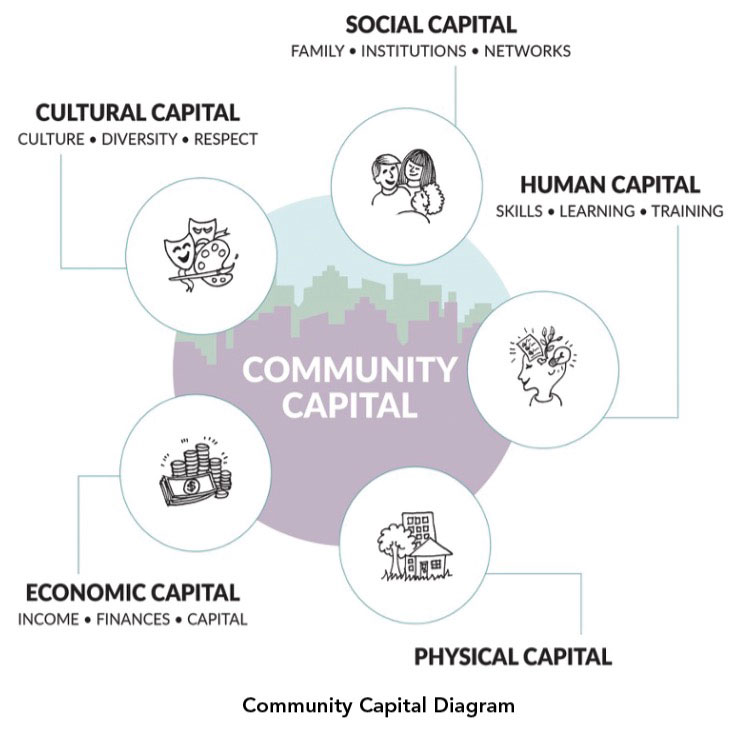
How construction can build Community Capital

Achieving the UN's Sustainable Development Goals through Integration of Social Procurement in Construction Projects

By David LePage and Tim Coldwell

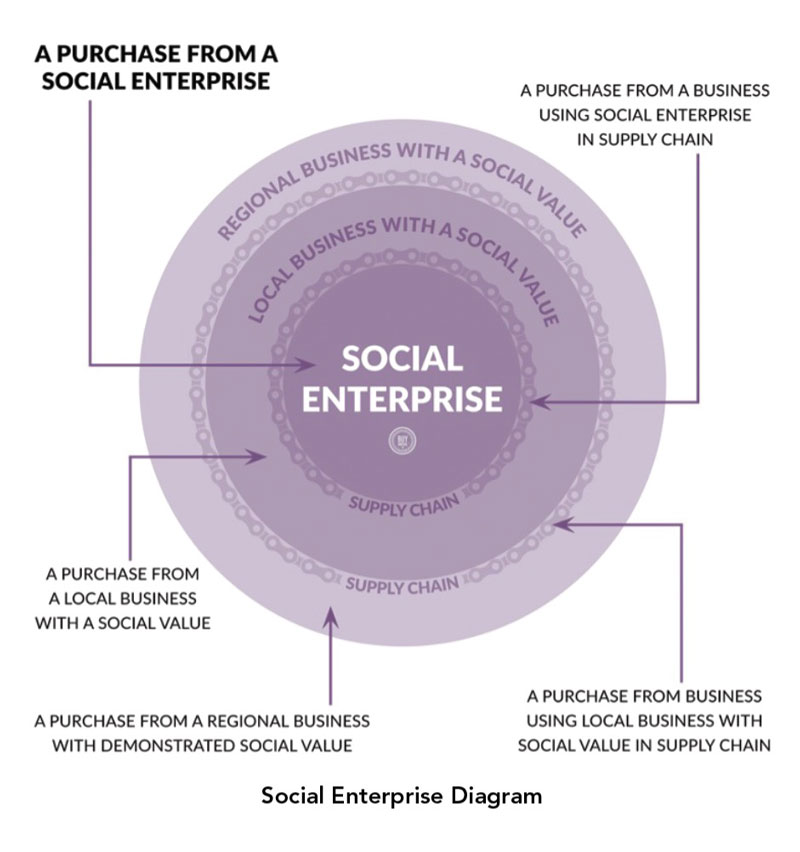
Every purchase has an economic, environmental, cultural, and social impact.  Social procurement is the intentional effort to leverage social value outcomes from existing purchasing.  With social procurement, price is no longer the only consideration; rather it is weighed against other factors.

When we use social procurement to purchase goods, services, or to choose a construction contractor, we are deliberately balancing the environmental impact, the social value outcomes, the product or service requirements, and the price.

Over the past decade we have witnessed the emergence of social procurement policies and initiatives across numerous corporate and political entities, as they adjust their historic purchasing criteria from lowest price to best value. Leveraging a social value from their existing buying offers an opportunity to solve persistent and complex social and environmental issues, which achieve the UN Sustainability Goals.

The Role of Government

Recognizing their purchasing power, governments have become the prime movers  in the social procurement initiatives. “As the largest public buyer of goods and services, the Government of Canada can use its purchasing power for the greater good. We are using our purchasing power to contribute to socio-economic benefits for Canadians, increase competition in our procurements and foster innovation in Canada.”

The size and breadth of governments’ purchasing power includes billions of dollars of spending every year on construction projects and infrastructure investments. From school building repairs, building a new firehall, a road replacement, or a new bridge, they all require hiring labour and purchasing a myriad of goods and services.

Social Value Market Place Demand & Supply

The purpose of social procurement and community benefit models is to leverage the demand side of the construction industry market to achieve added social value.  The more demand there is for a social value supplier, the more social value is created.

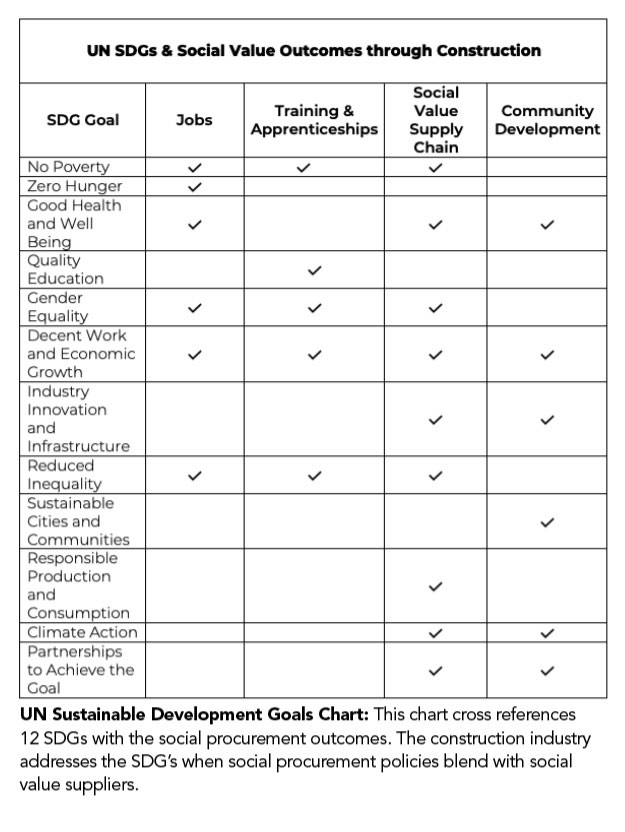
This global shift toward social procurement and community benefits in construction is a clear path to achieving multiple Sustainable Development Goals, SDGs. From ending poverty to impacting climate change, the construction industry holds a set of important keys to influence these outcomes.

Buy Social Canada is a social enterprise that advocates and supports the design and implementation of social procurement policy and programs. In its work across multiple projects Buy Social Canada has identified four key potential social value outcomes that can be achieved when social procurement is integrated into construction projects: jobs, training and apprenticeships, social value supply chain, and community development. 

Social Value Suppliers: Mike’s Story

(Although fictional, this narrative is emblematic of the challenges faced by many people wishing to establish, or

re-establish, a career path in construction.)

Mike, with seven years of experience as a Red Seal Carpenter, was injured on the job. The injury recovery required pain medication. The prescription led to a drug dependency which led to addiction, which led to Mike losing his health, his job, and benefits, and required a tough three-year struggle through recovery. Now Mike faced a new battle, with resume in hand, but a three-year gap in work. Those who doubted his potential to re-enter the labour market kept him unemployed. He faced self-doubt.

A friend recommended he go to check out Embers, since they hire day labour staff for the construction industry. Mike, with work boots, hard hat and tools from the EMBERS library, was on a job site the next day. Once on the job he was able to demonstrate his skills, and commitment to work a full day, every day.  Within three months the General Contractor on the project, seeing Mike’s skills and commitment, offered him a full-time permanent job. 

Mike’s journey is not that uncommon. This result happened because the General Contractor was meeting the requirements of a social procurement agreement on the work site. To meet social value targets to support hiring persons facing barriers to employment the GC had contracted EMBERS to provide day labour.

SUBSCRIBE TO THE DIGITAL OR PRINT ISSUE OF SABMAGAZINE FOR THE FULL VERSION OF THIS ARTICLE.
Roam Transit Operations and Training Centre

Light industrial meets the CAGBC Net Zero Carbon Standard

By Mike Woodland and Eric White

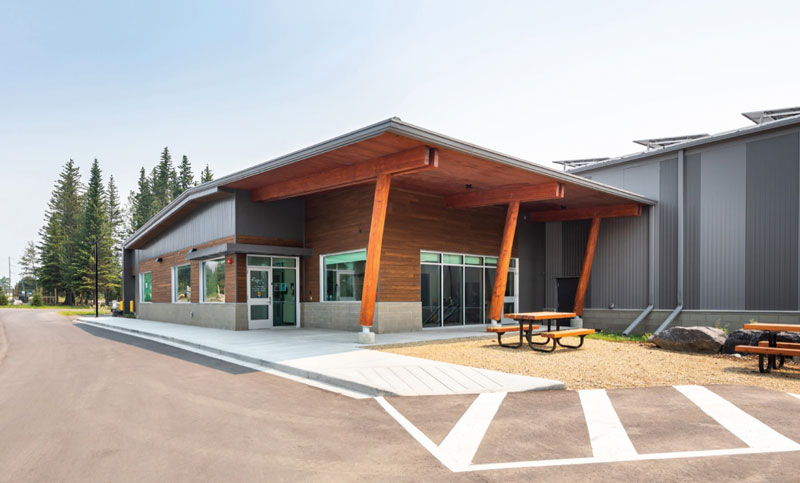
The design of the Roam Transit Operations and Training Centre responds to the challenge of creating a CAGBC Net Zero Carbon Standard facility in an area that is both a Canadian National Park and UNESCO World Heritage Site.

Operated by the Town of Banff, the new centre supports the operations of the Roam Transit bus fleet in the Bow Valley, encouraging the shift to alternative transportation in Banff National Park. The single storey 1,414 m2 building stores 12 buses inside, with a canopy structure to cover an additional 20 buses on the exterior. The building program also includes offices, a driver training classroom, a state-of-the-art training simulator, staff lunchroom, washrooms, and ancillary support spaces.

The facility will be used primarily for bus storage and fleet administration, although there is an area for light maintenance and a bus wash bay. Roam Transit currently operates four electric buses, with more on order. The buses are recharged overnight at this facility.

The Roam Transit Operations and Training Centre represents the unprecedented integration of several low carbon technologies including ultra-efficient mechanical systems, a super-insulated building envelope, district heating from a biomass waste-to-energy plant, solar photovoltaics, and electric bus charging.

High Performance Building Envelope

The building envelope incorporates a combination of insulated metal wall panels with 152 mm of rigid insulation and hybrid walls with 102 mm rigid and 140 mm mineral fibre insulation giving an R-value of R-44.6 for the storage area walls and R-34 for the administration area walls. The storage area roof contains 406 mm of fibreglass insulation, while the hybrid administration roof integrates 152 mm of rigid insulation and 102 mm of fibreglass insulation to provide R-values of R-43 and R-33 respectively. Triple pane glazing with double low-E coatings, argon fill, and warm edge spacers are incorporated into thermally-broken aluminum framing with glazing U-values of 1.14 to 1.42.

Mechanical and Electrical Systems

Strategies to improve the efficiency of the mechanical and electrical systems include: 63.8% effective heat recovery on the storage area HVAC system; 83% sensible heat recovery for the administration area HVAC system; variable speed, high-efficiency hot water pumps; and lighting controlled by occupancy sensors.

Project Credits

  • Owner/Developer  Town of Banff
  • Architect  MTA Urban Design Architecture Interior Design Inc.
  • Structural engineer  ISL
  • Mechanical engineer Remedy
  • Electrical engineer  SMP
  • Civil engineer AND Landscape ARCHITECT  ISL Engineering
  • General Contractor  PCL Construction
  • CaGBC LEED and ZCB Consulting Services Integral Group
  • Energy Modelling and Commissioning  Integral Group
  • Photos  Lattitude Photography

Project Performance

  • Total energy use intensity = 88kWh/m2/ year
  • Thermal energy use intensity (TEDI) = 34 kWh/m2/year
  • Summer peak demand = 23.6kW
  • Winter peak demand = 23.5kW

Mike Woodland, AAA, AIBC, MRAIC, LEED AP is a principal at MTA | Urban Design Architecture Interior Design Inc.  Eric White, Dip. A.T., CPHC, LEED AP BD+C, Homes, WELL AP IS Associate, Sustainability at Integral Group.

SUBSCRIBE TO THE DIGITAL OR PRINT ISSUE OF SABMAGAZINE FOR THE FULL VERSION OF THIS ARTICLE.

St. Benedict Church

Achieving net-zero-energy sets the bar high for community buildings

By Michael Nicholas-Schmidt and Roberto Chiotti

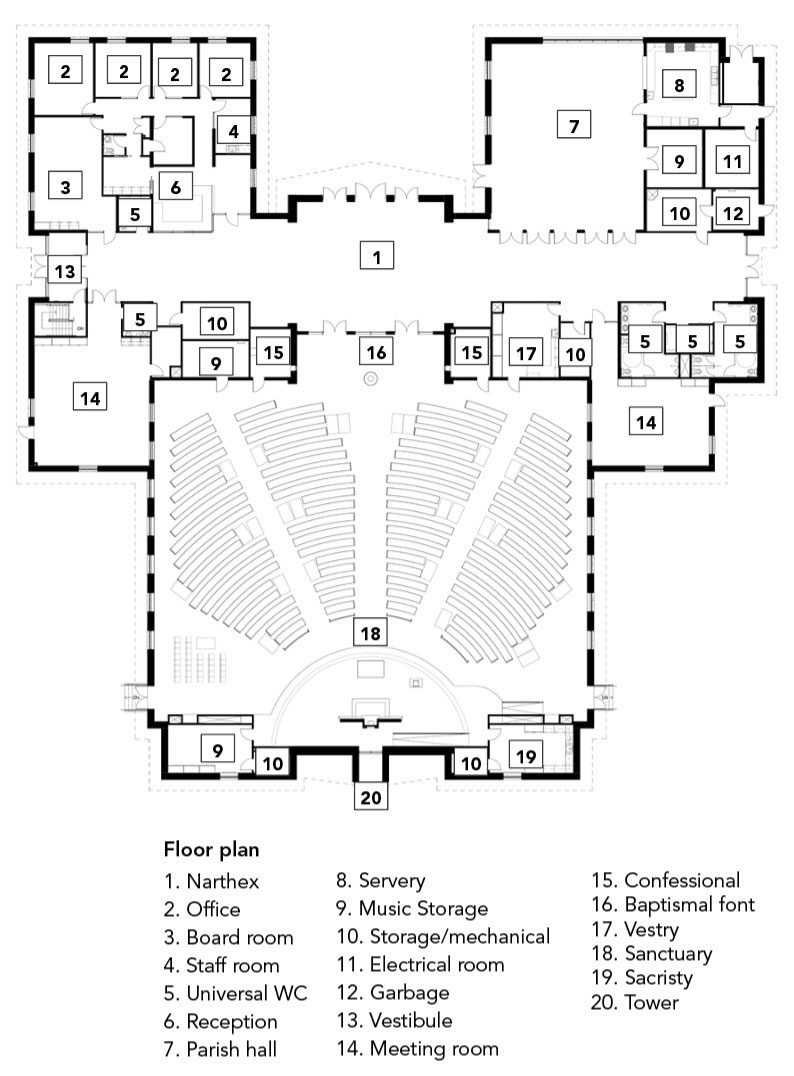
This new suburban church in Milton ON was designed in response to the 2015 Papal Encyclical Laudato si’, On Care for Our Common Home; a call to action to address the ecological crisis facing all life on earth. The document affirms that issues of economics, social justice, and ecology are inseparable.

Thus, the parish wanted to create a welcoming facility, not only for their own faith community but also for the broader community they serve. The building program is organized to embrace a central entrance courtyard and gathering space. Both the worship space and social hall have expansive glazing to ensure that the community activities taking place within are visible to all.

In terms of energy use and environmental impact, the parish established goals for the project of net-zero operating energy with net-zero carbon emissions and a substantial reduction in the embodied carbon of the completed building. To that end, the building envelope was designed with R-60 effective for the roof, R-35 effective for the walls, R-15 effective for the slab on grade and buried ductwork, and R-8 for exterior glazing. Careful consideration was given to the elimination of thermal bridging; superior air tightness and the incorporation of a 95 KW Solar photovoltaic system.

Another goal was to source and specify local materials and labor to better support the regional economy; and to use natural materials wherever possible. Ninety-five percent of all materials and labour were regionally sourced; including structural wood components for the roof, locally quarried stone, and locally produced steel roofing.

Project Credits

  • Architect  Larkin Architect Limited
  • Owner/Developer  The Diocese of Hamilton
  • General Contractor  Melloul-Blamey
  • Landscape Architect Vertech Design
  • Civil Engineer  Basetech Consulting
  • Electrical Engineer  Rombald Inc
  • Mechanical engineer  Zon Engineering
  • Structural Engineer  WSP
  • Commissioning Agent  HTS
  • Energy Modelling  Hadlock Consulting
  • Renewable Energy  Zon Engineering
  • Photos  Scott Norsworthy

Project performance

  • Energy intensity (building and process energy) = 65.9KWh/m2/year
  • Energy intensity reduction relative to reference building under MNECB
  • 2015 as modified by SB-10 = 31%
  • Reduction in water consumption relative to reference building
  • under LEED = 50%
  • Recycled material content by value = 4%
  • Regional materials (800km radius) by value = 95%
  • Construction waste diverted from landfill = 80%
  •  

Michael Nicholas-Schmidt, BES, M.ARCH, OAA, MRAIC and Roberto Chiotti, BES, BARCH, MTS, OAA, FRAIC, LEED™ AP are Principal and Founding Principal at Larkin Architect Limited.

SUBSCRIBE TO THE DIGITAL OR PRINT ISSUE OF SABMAGAZINE FOR THE FULL VERSION OF THIS ARTICLE.

Interview with Graeme Stewart of ERA Architects

Graeme Stewart is a principal of ERA Architects which was the lead architect of the Ken Soble Tower transformation, one of the largest EnerPHit-certified projects in the world. www.eraarch.ca
1. How did ERA Architects become involved in the Ken Soble Tower project?

ERA Architects had been working for over a decade on the Tower Renewal Project, a strategy for the revitalization of Canada’s aging postwar apartment neighbourhoods, through which we gained experience on tower retrofits. As part of the Hamilton City Housing portfolio of buildings, the Ken Soble Tower was in a distressed, abandoned condition. Based on our experience, we were brought in to do an assessment of what to do: tear it down or retrofit.

2. Deciding to do an EnerPHit transformation was a bold decision. How did you arrive there?

I am pleased to say that the decision was largely made for us by Hamilton City Housing CEO Tom Hunter. He came from the health care sector and said that we build world-class hospitals and need to do the same for our public housing. He understood the long-term benefits of doing an EnerPHit transformation, and the project moved ahead from there.

3. Once the project was a go, how did the process work of coordinating the various disciplines in the team?

When Hamilton City Housing decided on pursuing EnerPHit the intent from the start was to achieve certification. This kept everyone ‘honest’. It was crucial to have a fully co-ordinated team which we assembled based on our experience. The team included: Entuitive, JVM Consulting, Transsolar, Reinbold Engineers and the certifier from PHI in Germany among others. At every step – during design development, review of assemblies, costing reviews – the team always asked if we were meeting PHPP targets. We then worked with PCL on construction mock-ups that would meet the criteria of EnerPHit and serve as the standard should alternate details or products be suggested by the trades. Through this process we arrived at a tight ‘specs package’ such that the project met performance and was ultimately certified.

4. What did you learn from this first project about what worked and what could be improved?

As far as we know, this is the largest residential EnerPHit project in the world. The precedents for this type of work come from Europe but we realized that we need solutions that meet North American practices, products and trade familiarity. Our design made this its focus. The construction manager PCL was critical in the strength of their quality control regime, but some trades wondered early on if the PassiveHouse was overkill.  Yet as testing procedures became easier the consensus was these were key practices for use in future projects, Passive House or overwise.

There are two other observations. We would love to have trades more familiar with high-performance retrofits, and a supply chain that can provide more of the types of products for this type of work. But the evolution will happen. Since we went to tender three years ago, many more suitable products have become available.

5. Is the Ken Soble Tower transformation a practical template for the many similar towers in our building stock?

A resounding yes. The project gave us a lot of elbow room to try things because it was empty. We can apply the lessons learned to an occupied building. It was cheaper by half to renovate the Ken Soble Tower rather than tear it down and replace. The economics will improve further as the supply chain and trade skills improve. The incentive is an improved quality of life in revitalised buildings that are quiet, more comfortable, and more economic to operate in the long term.