Dedicated to sustainable,
high performance building

Charting New Territory in Passive House

Clayton Community Centre
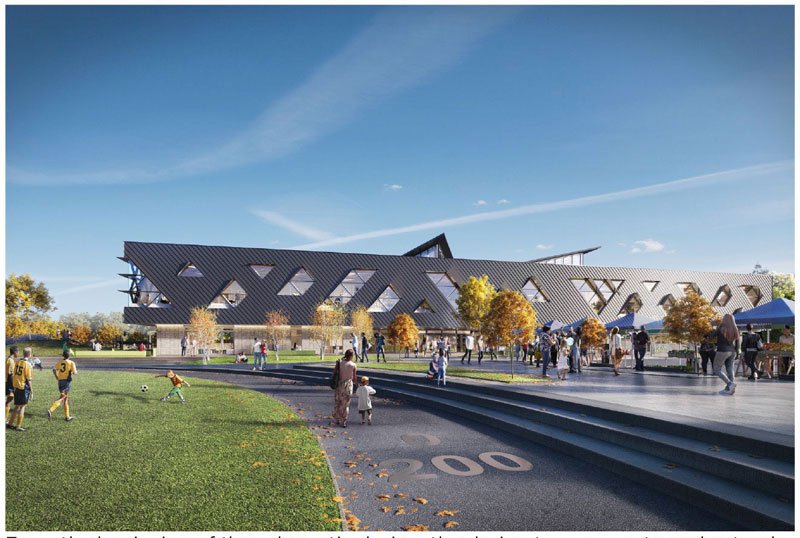
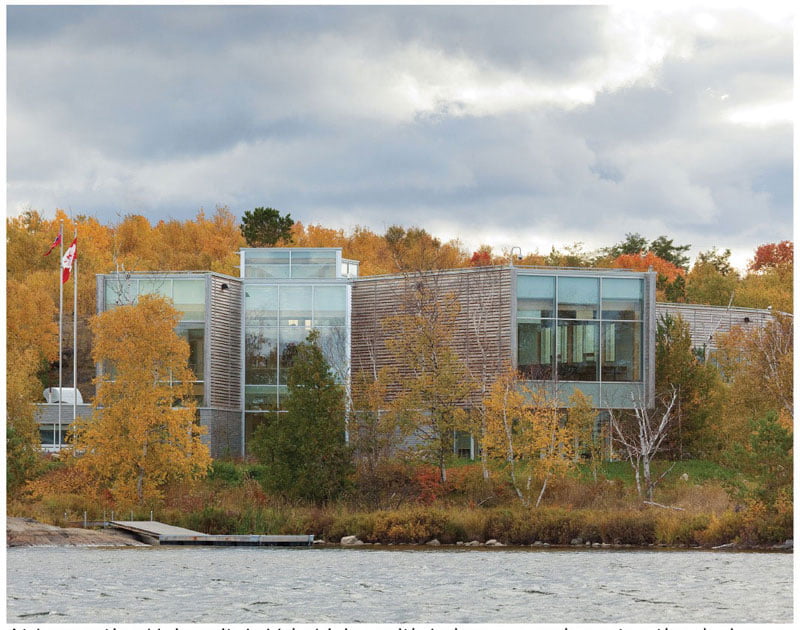
Located in Surrey BC, the Clayton Community Centre combines three key uses: a visual and performing arts centre, a community library and a recreation centre. The design approach for the project was to move beyond simply co-locating these centres and instead truly integrate them into a single community building.

By Melissa Higgs, HCMA Architecture + Design

The site is heavily forested, an increasingly rare condition that informed the architectural response and program organization. The concept for the building is a forest, with diverse uses collected within the tree canopy. Between the three key program blocks, a large open, unprogrammed space on the ground floor evoking a clearing in the forest, acts as a gathering space.

Energy Considerations

While the desire for integration was a key driver in locating the spaces within the building, another was the very aggressive, ultra-low energy targets set for this project. While Passive House is a more common standard in Europe, the Clayton Community Centre will be the first community centre in North America to achieve the standard, and at 7500m² is believed will be the largest PH certified community centre in the world.

A North American Precedent

As much of the Passive House work in North America has been realized in the residential sector, whether small or large scale, there are few completed non-residential projects from which to learn. By designing complex non-residential buildings, design professionals are covering new ground or “charting new territory”.

The purpose of this article is to identify challenges and share learnings regarding the design of large-scale Passive House civic buildings in a North American context.  The project team learned early on that the process of design would be significantly different than that for a similar building designed to even the most ambitious energy targets of the more familiar LEED certification system.

At the beginning of the schematic design, the team came to understand that Passive House objectives would be a significant driver on the building’s form and layout.

Sun path studies were primary informants of the orientation of key spaces including the fitness centre and gymnasium—which was sometimes in opposition to other key objectives for spatial arrangement.

Simultaneously, the project team realized that the process with their client needed to shift dramatically. The project team worked closely with the clients from very early on to anticipate each room’s use and occupancy pattern (operating hours, types of equipment, numbers of computers for staff, etc.). This step was key to having an accurate estimation of plug loads and occupancy schedules, at a stage where the overall design and the client’s ability to anticipate operational details were not yet fixed.

Developed from those assumptions, the first PHPP model caused the design team to realise that the challenges this project was going to encounter—namely the high cooling loads and Primary Energy Renewables—were different than any typical residential Passive House project.

By Melissa Higgs, HCMA Architecture + Design. Mechanical content support from Integral Group.

SUBSCRIBE TO THE DIGITAL OR PRINT ISSUE OF SABMAGAZINE FOR THE FULL VERSION OF THIS ARTICLE.

Resilience planning for communities to thrive in an unpredictable and changing world

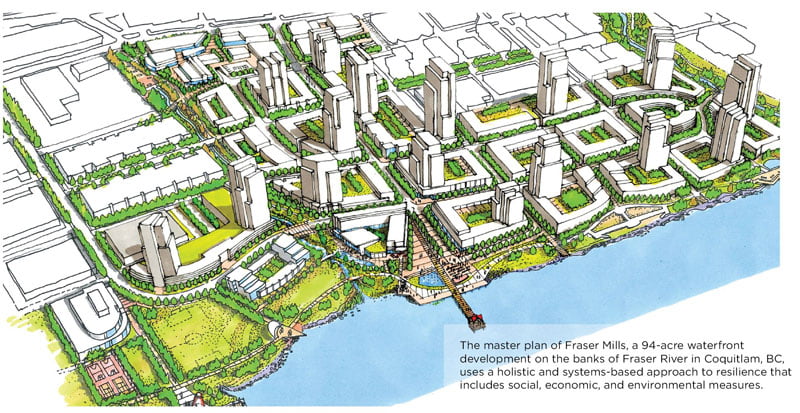
Across Canada, we are witnessing tremendous change, not only in our climate, but also in the urbanization of our cities. As our cities grow, we are experiencing greater pressures on our housing stock and community-wide infrastructure. In an often unpredictable and changing world, resilient design and planning is needed for our cities and communities to endure and thrive in both the short and long-term.

By: Kathy Wardle and Viren Kallianpur

While we must be aware of potential short and long-term shocks and threats facing our communities, as design professionals we have both a responsibility and an opportunity to implement solutions that offer hope to Canadians. This article offers a perspective on resilient design: the guiding principles, best practices, and tools that are available to practitioners today.

There is both commonality and differences in the various Canadian cities in terms of their stressors and threats. With four out of five people in Canada living in cities, the resulting higher density and population in urban areas mean that cities are both agents for climate impacts and solutions.

Growing population through migration and immigration, the rising demand for transportation, and the growing need for infrastructure to provide safety, comfort, and security all combine to create different pressures on our cities.

The global nature of the world we live in also means that stressors and threats faced by other nations have either a direct or an indirect impact on our cities. While global in nature, these impacts need to be resolved at the local level through political will, technical expertise, and individual commitment and responsibility. The effort to find solutions to these issues or problems lie in a more collaborative and collective approach through leadership, community engagement, and collective action.

While climate change is one of the most important drivers for discussions regarding resilience, the conversations should not be limited to climate change; resilience needs to be looked through social, economic, and environmental lenses to identify risks—natural and manmade, acute and chronic—and respond through design and operations planning. Resilience needs to be addressed at multiple levels from a single building, to a district, city and regional level. Policies, strategies, and initiatives at each scale influence the resilience and performance at other scales.

Kathy Wardle, LEED BD+C RELi AP, is Associate Principal, Director of Sustainability, and Viren Kallianpur, AICP, LEED AP BD+C, RELi AP, is Associate, Urban Design Practice, both of Perkins+Will in Vancouver.

SUBSCRIBE TO THE DIGITAL OR PRINT ISSUE OF SABMAGAZINE FOR THE FULL VERSION OF THIS ARTICLE.

Viewpoint

University District, a new 80-hectare mixed-use neighbourhood in northwest Calgary, welcomed its first residents in 2018. The masterplan for the community was created by West Campus Development Trust (WCDT) through a public engagement process that set new standards of authenticity and transparency for projects of this type. The process helped WCDT to refine its plans, build trust with stakeholders and attract buyers.

Transparency Builds Trust

The traditional approach to redevelopment has been “design and defend,” where the developer finalizes a plan and then reveals it to the public. The trouble with design and defend is that it can spark resistance and resentment in neighbours and other stakeholders.

Rather than designing and defending, James Robertson, President &CEO for WCDT and his team   adopted a “transparency builds trust” approach.

Stakeholder Working Groups

The land that became University District is surrounded by five established neighbourhoods, the Foothills Medical Centre and it’s also home to the Alberta Children’s Hospital, the Ronald McDonald House and the University of Calgary. WCDT decided to establish relationships with all these stakeholders as early in the process as possible. WCDT recognized early on that you can’t just come into an area in the middle of established, well-loved communities and assume you can build whatever you want.

In redevelopment projects, the developer usually begins to meet the public as part of the land use re-designation application process. For University District, the public engagement project began well in advance of this stage, with a series of Stakeholder Working Groups. Each of these meetings, which functioned more like committees than open houses, focused on a single element of community design.

Each event included representatives from the surrounding communities and the main stakeholders, as well as the WCDT design team. This ongoing interaction was invaluable in building constructive relationships and helping to align the project goals with community needs. 

Each Stakeholder Working Group opened with a review of the decisions made at the last meeting. WCDT set clear deadlines for feedback so that stakeholders understood their responsibilities. When it came time for the City’s public hearing on the land-use re-designation, there was little or no opposition – an unusual situation in a city where redevelopment has often been the source of time-consuming conflict between developers and citizens.

Setting a Collaborative Tone

Next, WCDT held three open house meetings (the last of which was required by The City as part of the redevelopment application process). Breaking with tradition, each open house took place over two or three days, and in multiple locations to suit different stakeholder groups. Participants were offered different opportunities to participate, according to their individual preferences and schedules. WCDT considered it important to change the messaging from ‘the usual ‘Come to this open house to see what we’re doing,’ to ‘Come to this open house to see what we’re all doing.’

At the meetings, WCDT displayed large information boards, and participants placed Post-It Notes directly on these boards to indicate approval, concerns and/or disagreements. The WCDT team would then photograph the boards, compile all the feedback (positive and negative) and report it back to the participants and communities. These notes were also given to the WCDT design team to analyze and consider.

Recognizing that not everyone can attend meetings, and the opinions offered may not represent the views of everyone affected by the development, WCDT also posted an online survey, set up storefront information booths, and wrote letters directly to communities soliciting questions and comments.

This inclusive approach to engagement proved popular with the public. During the approvals process, all five surrounding communities submitted a letter to the City of Calgary expressing their support for the University District Plans – an unusual, perhaps unprecedented, expression of support.

This article, originally published by Smarter Growth, a program of the BUILD Calgary Region initiative, was adapted for SABMag by Maureen Henderson, Director of Marketing and Communications for the West Capus Development Trust.


SUBSCRIBE TO THE DIGITAL OR PRINT ISSUE OF SABMAGAZINE FOR THE FULL VERSION OF THIS ARTICLE.