How building automation enables
continuous improvement after certification
By Sally Glover
For a newly completed building, certifications like LEED and WELL are important achievements. But certification alone doesn’t guarantee how the building will perform in the decades to come.
How will it operate as equipment ages, climate conditions change, and occupancy and operating needs evolve? At the University of British Columbia, buildings used 60 percent more energy over the 10 years preceding 2023 than projected by their proposed LEED energy models—a gap attributed partly to commissioning shortfalls. Although the finding is specific to one campus, it demonstrates how significantly design assumptions and real-world operation can diverge.
As the built environment moves toward zero-carbon buildings, closing the gap between intended and actual performance becomes critical. Carbon targets are based on measured energy use rather than design intent, a focus reflected in programs such as the Canada Green Building Council’s Zero Carbon Building—Performance Standard, which evaluates operational performance annually. LEED for Operations and Maintenance similarly requires ongoing data tracking and recertification.
This is the building performance challenge that follows certification: ensuring the building can sustain—and ideally improve—its performance as conditions change. When design intent meets the reality of the building in service, life cycle energy models are essential for estimating future consumption. But even the most carefully considered model depends on assumptions about occupancy, schedules, weather, plug loads, equipment operation, occupant behaviour, and so on.
The moment a building is occupied, those assumptions begin to change. Teams grow. Employees work different hours. Spaces are repurposed. Sensors drift out of calibration, or new equipment might be added without updating control sequences. Such changes are evidence that buildings are dynamic systems. A building designed for one set of conditions can’t remain efficient if its operation doesn’t evolve with changing needs. The scale of the opportunity is significant in both new and existing buildings.
Natural Resources Canada says commissioning new buildings can deliver average annual energy savings of 10–15 percent. For existing buildings, recommissioning—including optimizing mechanical systems, lighting, and controls—typically yields savings of 5–15 percent, in some cases 30 percent. Building automation can help close the performance gap by making operating conditions visible and empowering facilities teams to identify and correct inefficient operation quickly.
A building that continued to change
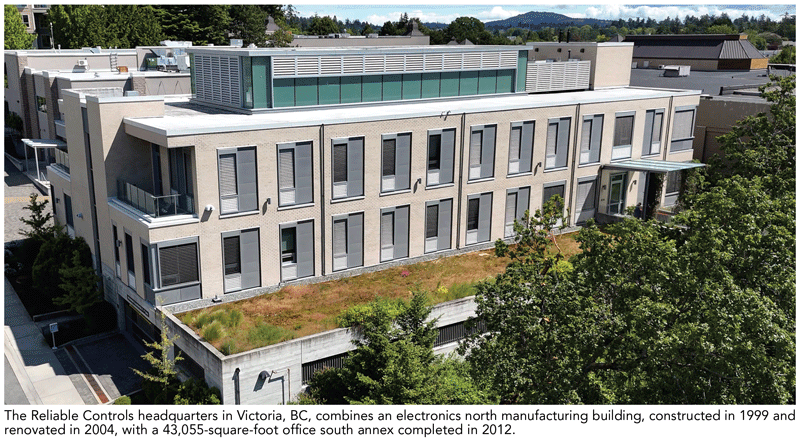
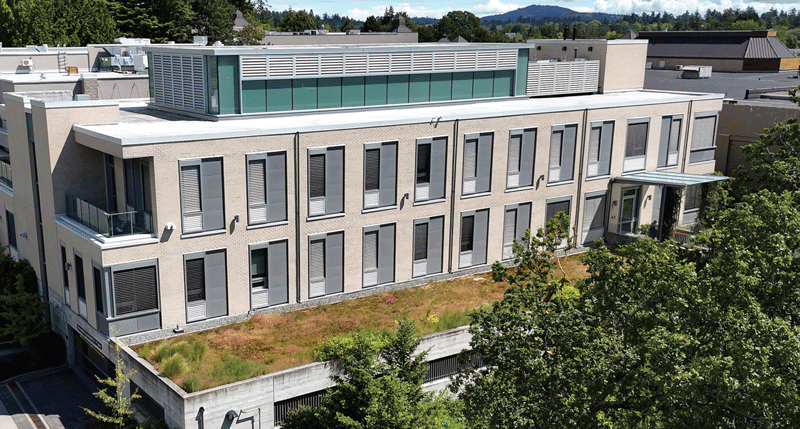
The Reliable Controls headquarters in Victoria, BC, offers a long-term case study in how building automation can support sustained performance. The site combines an electronics manufacturing building, originally constructed in 1999 and renovated in 2004, with a 43,055-square-foot office annex completed in 2012. The south annex accommodates hardware design, marketing and communications, finance and administration, and human resources in two stories of offices above two levels of parking.
It earned LEED Platinum certification in November 2013—the first building in its municipality to do so. The south annex was designed to reduce energy demand and support occupant comfort. Natural ventilation relies on 57 trickle vents integrated with a radiant-floor heating and cooling system to keep occupants comfortable and energy consumption low.
Daylighting, exterior sunshades, and individually controllable lighting and temperature settings allow conditions to respond to the people using each space and help reduce unnecessary operation.
At the design stage, the annex’s modelled regulated energy costs were 54 percent lower than those of a reference building meeting ASHRAE 90.1-1999 standards. This figure represented projected performance under the assumptions used for LEED certification—not a guarantee of how the occupied building would perform over the following decades.
Energy efficiency was also part of a broader sustainability strategy. Rainwater is collected in two cisterns for toilet flushing and irrigation, contributing to a 60 percent reduction in potable-water use compared with the project baseline. Rain gardens and bioswales manage stormwater. Bicycle storage, showers, and an incentive program support lower-carbon transportation.
Sally Glover, Brand & Communications Strategist, Reliable Controls for the article.
SUBSCRIBE TO THE DIGITAL OR PRINT ISSUE OF SABMAGAZINE FOR THE FULL VERSION OF THIS ARTICLE.