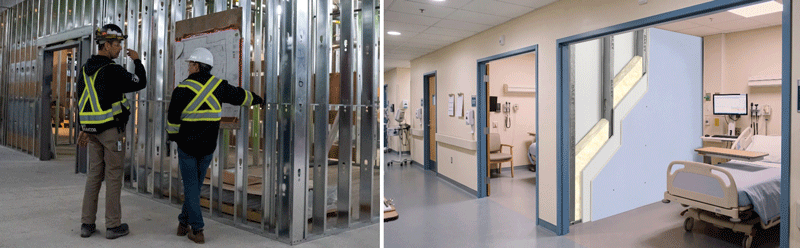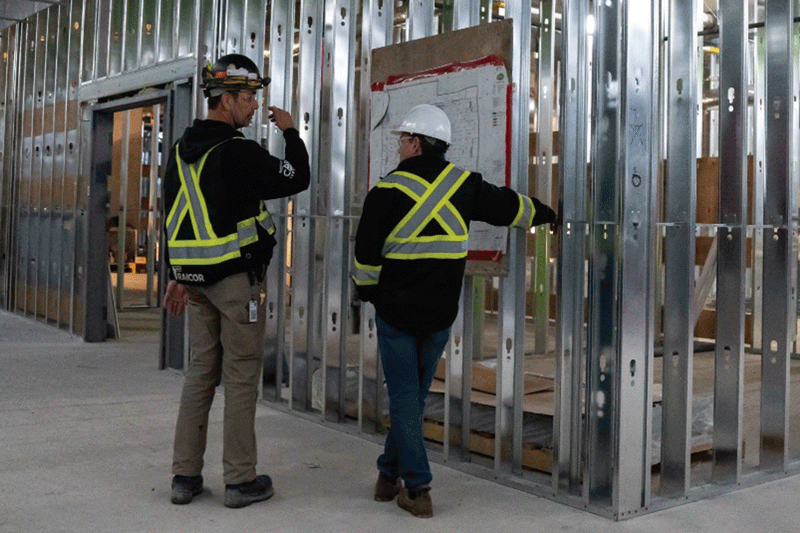
Walls are more than just space dividers; they are critical building components that help protect occupants, enhance privacy, support productivity, and withstand the demands of daily use. Designing interior spaces across the institutional, commercial, and industrial segments requires wall systems that deliver a multitude of performance benefits.
Fire-rated wall assemblies are commonly designed to provide 1- to 2-hour fire resistance ratings, helping contain fire and smoke to meet building code requirements.
Research indicates that noise distractions can result in productivity losses of up to 86 minutes per employee per day in offices. In schools, poor acoustics can cause students to miss up to 25% of spoken words, emphasizing the need for sound-controlling wall and ceiling assemblies. Acoustically, wall performance is measured using Sound Transmission Class (STC) ratings – standard drywall partitions typically achieve STC 35-40, conference rooms STC 45, and spaces requiring confidential discussions can require STC 53+.
Durability is equally important in healthcare, education, and industrial facilities, where walls must resist impacts, moisture, abrasion, and frequent cleaning.
Increasingly, stakeholders across the construction value chain prefer lightweight steel stud framing, gypsum board systems, modular panels, and composite wall assemblies, to accelerate installation and improve sustainability while delivering the required performance.
SUBSCRIBE TO THE DIGITAL OR PRINT ISSUE OF SABMAGAZINE FOR THE FULL VERSION OF THIS ARTICLE.