By Vince Catalli
In collaboration with Circular Construction Canada (CCC), Canadian Standards Association (CSA Group) is driving an initiative to help transition Canada’s construction sector from a linear “take-make-dispose” model to a circular, net-zero, and low-carbon economy. This initiative focuses on developing standards and a strategic framework to promote the reuse of materials, adaptive design, and the extension of building lifespans to reduce life cycle environmental impacts.
Nature as Inspiration
Nature is the perfect design process operating as a balanced net-zero, closed-loop system where there are no wasted resources. A balanced net zero closed-loop system is an integrated, sustainable model that eliminates waste and reduces greenhouse gas (GHG) emissions by continuously cycling resources and energy within a self-sustaining system, balancing any necessary inputs with equivalent removals.
Canada generates approximately 4 million tonnes of construction, renovation, and demolition (CRD) waste annually (approximately 1.8 million tonnes of embodied carbon), accounting for roughly 12% of the country’s total solid waste. While estimates vary, this represents a significant portion of landfill content, with only about 16% to 20% currently diverted through recycling or reuse.1
At the same time, in 2025, a year’s worth of biological resources were used in just 6.7 months, in other words, the equivalent of 1.8 Earths’ worth of resources would be needed for the entire year of 2025. 2 This will only get worse as developing countries’ economies progress. It is clear that our linear system of “take, make, waste” is increasingly destructive and unsustainable, with potentially catastrophic consequences.
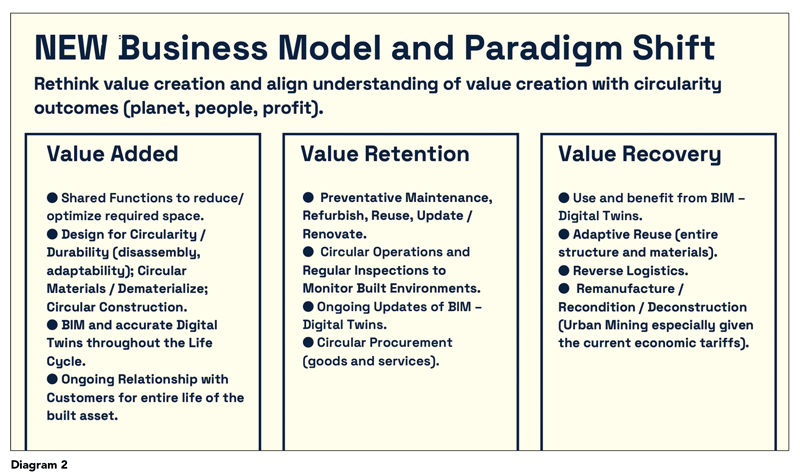
The Circular Built Environment (CBE) approach combines circular economy principles (closed-loop resource use for extended lifespans) with net-zero targets (reducing input loads, offsetting emissions, and relying on renewable methods) to create a restorative rather than destructive impact on the natural and built environment.
Used together, “balanced” emphasizes the equilibrium (inputs=outputs), while “net zero” focuses specifically on carbon (emissions=removals). In essence, a “Balanced Net Zero Closed Loop” pathway refers to a strategic, holistic, and cost-effective approach to circularity (eliminating waste), based on modified approaches and systemic changes.
A Paradigm Shift
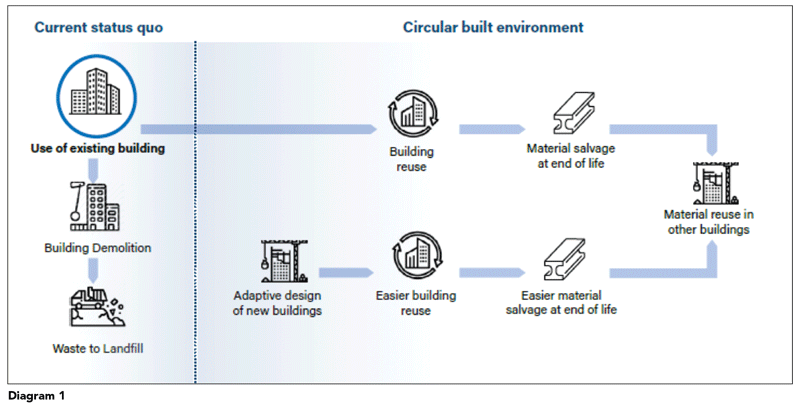
CBE represents a paradigm shift for our industry, responding to global advances within the Circular Economy space. At its core, CBE strives to “eliminate waste” using balanced net-zero closed-loop approaches to managing resource inputs to the built environment. These inputs include material resources, energy, and water. As an example, the following life cycle animates the circularity of material resources and the shift that is being proposed. (Diagram 1).
SUBSCRIBE TO THE DIGITAL OR PRINT ISSUE OF SABMAGAZINE FOR THE FULL VERSION OF THIS ARTICLE.