

Systemair Introduces Next-Generation Topvex SR and TR Air Handling
Units for High-Performance Buildings
Systemair, a leading global supplier of high-quality ventilation, heating, and cooling products and systems, has updated its Topvex SR and Topvex TR air handling units to bring a new level of efficiency, flexibility, and control to commercial ventilation. Prioritizing energy performance and healthy indoor environments, the new Topvex models deliver high-efficiency rotary heat recovery, a compact footprint, factory-integrated controls, and a broad airflow range, making them a strong match for offices, schools, mixed-use residential projects, and other commercial spaces. The units are engineered to simplify design and installation without sacrificing performance—an important advantage as projects push for faster timelines and stronger energy results. The performance and flexibility of the Topvex models gives engineers a reliable option for Basis of Design (BOD), while contractors and facility teams gain equipment that’s practical to install, operate, and maintain.
Information: rick.caldwell@systemair.net
 RAIC Report
Reframing Value: Transforming How Canada Procures Architectural Services
By the RAIC Fees and Procurement Working Group
At the 2025 Conference on Architecture hosted by the Royal Architectural Institute of Canada (RAIC), the Fees and Procurement Working Group convened a national discussion on one of the profession’s most persistent challenges: the misalignment between architectural fees, procurement practices, and the true value architects deliver.
Structured around six guiding questions, the session drew practitioners from across the country to reflect on systemic barriers, regional disparities, and practical reforms. What emerged was a shared call to reimagine how architectural services are defined, selected, and compensated, ensuring that they reflect architecture’s essential role in advancing sustainability, quality of life, and public interest.
Delegates agreed that architecture remains widely misunderstood as a luxury or artistic service rather than a professional discipline that contributes to public health, safety, and economic resilience. They emphasized the need to reposition architects as strategic actors who serve the public good through evidence-based design and community impact.
Participants called for stronger communication tools to help architects demonstrate the long-term value of design decisions, particularly those made early in the project lifecycle. The RAIC’s continued leadership in providing advocacy resources and public education materials was viewed as vital to this effort.
Fee-based competition dominated the discussion. Delegates described how undercutting, lowering fees below sustainable levels to secure work, compromises quality, limits innovation, and creates ethical tension within the profession.
Regional inconsistencies in billing, coupled with rising liability insurance costs, were identified as compounding pressures. Participants called for professional bodies to promote ethical fee practices and to strengthen national standards that reward qualifications and design excellence, not the lowest bid. The creation of a national architectural policy was seen as one path toward consistency and reform.
Delegates proposed a range of procurement reforms to promote fairness and transparency, including the adoption of qualification-based selection (QBS), standardized RFP templates, and reduced weighting of price in evaluations. Aligning scope, deliverables, and evaluation criteria was considered critical to managing risk and achieving better project outcomes.
Participants encouraged the RAIC to continue advocating with public-sector clients for more equitable procurement systems and to equip firms with practical tools and training to pursue such opportunities.
A recurring message was the need to shift public and client perception: architecture should be seen not as a cost but as an investment. Well-designed buildings yield economic, environmental, and health benefits that extend far beyond construction.
Delegates recommended clearer, phased breakdowns of professional services to improve client understanding and counter misconceptions about design fees. Many also noted confusion around the RAIC Fee Guide’s interpretation and use across jurisdictions, underscoring the need for consistent communication and regional engagement.
Participants examined alternative fee models and international best practices, such as the RIBA fee calculator, outcome-based contracts tied to post-occupancy performance, and structures that scale with project complexity or community impact.
They also highlighted opportunities to integrate technology to increase transparency and expand service offerings, through digital design review, lifecycle analysis, and participatory planning, helping firms demonstrate broader value.
Advocacy was identified as a cornerstone of lasting change. Delegates called for coordinated campaigns, videos, awards, and thought-leadership content that communicate architecture’s societal value to clients, policymakers, and the public. Collaboration with allied professions was seen as key to amplifying the message.
A strong recommendation emerged for the RAIC to develop advocacy and communication toolkits that help member firms articulate the link between fees, scope, and outcomes in ways that resonate beyond the profession.
The session was viewed as a starting point for sustained action. Delegates urged the RAIC to continue advancing initiatives such as a national construction cost calculator, procurement process reviews, and updates to the RAIC Fee Guide.
Through unified advocacy and evidence-based reform, Canada’s architectural community can ensure that architectural services are not only fairly compensated but also recognized as essential investments in sustainable, resilient, and inclusive communities.
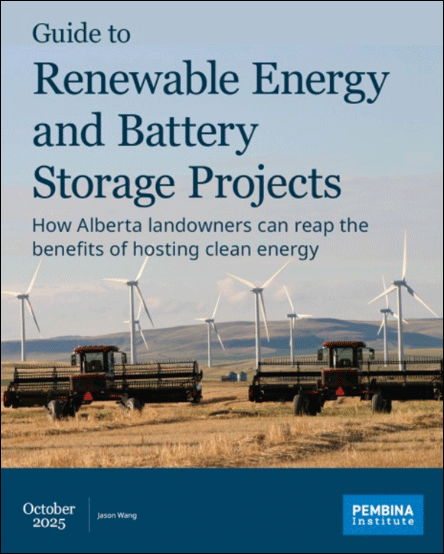 New guide offers tips to landowners considering clean energy projects
A just-released guide from the Pembina Institute, Guide to Renewable Energy and Battery Storage Projects, covers everything from basics about renewables to thoughts on how to help maximize benefits and minimize impacts. There’s a section for municipalities on how they can get involved in renewable energy development. And to wrap it all up, there are lists of questions on a variety of topics that offer solid starting points for conversations with developers proposing projects.
 New Book: Canadian Architectural Styles:
 A Field Guide
Lorimer Publishing has launched its new book by Don Mikel, an acclaimed architecture scholar and heritage consultant with decades of experience researching and restoring Canada’s historic buildings. $39.95 CAD, and available through Indigo, Amazon, local independent bookstores, and lorimer.ca.
 In memory: George Baird
George Baird, founding principal of Baird Sampson Neuert architects and member of the Order of Canada, has died. He was Professor Emeritus and former Dean (2004-2009) of University of Toronto’s John H. Daniels Faculty of Architecture, Landscape, and Design, and founding partner of the Toronto-based architecture firm Baird Sampson Neuert architects.

Selected listings from the SABMag Directory of Sustainable Products and Services for Sustainable, High-Performance Building
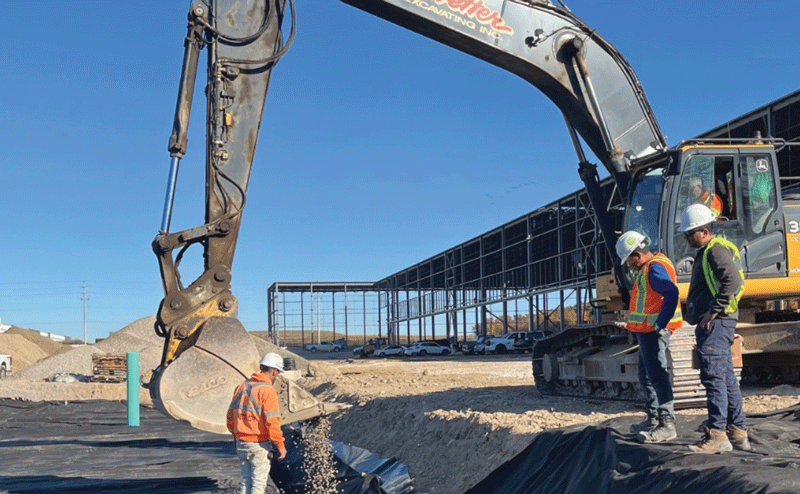 ACO Systems – ACO drainage products protect people from water, and water from people. Every ACO product safely controls water as it passes along the chain to ensure that it can be ecologically and economically reused in a viable way.
 Airfoam Industries – Manufacturer of high-performance building envelope products. With insulation solutions for residential, commercial, and industrial applications, build your LEED building with Airfoam.
 Aqua-Tech Sales and Marketing Inc. – High-efficiency condensing boilers and water heater products manufactured by Lochinvar.
 Canadian Precast Concrete Quality Assurance Certification Program – Qualifies the capabilities of precast concrete manufacturers who fabricate precast concrete products of all types.
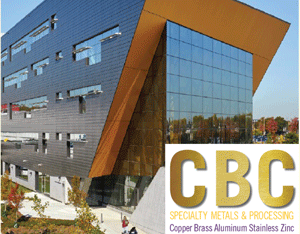 CBC Metals and Processing/ Zinc – Muntz Metal, Architectural Bronze, Silicon Bronze, Coppers, Brasses, Aluminum; Stainless Steels; Coloured Stainless Sheet and Anodized Aluminum; CBC EZ Metal.
 FABRIQ architecture – A Montreal-based firm that delivers innovative and sustainable design solutions for clients across Canada. Several LEED projects are currently certified or underway.
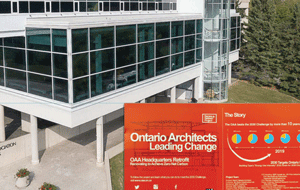 INLINE Fiberglass – Our fiberglass windows and doors offer: Time-tested durability; Superior energy efficiency; Residential and commercial applications in LEED-certified projects. INLINE Series 3000 windows are Passive House International certified.
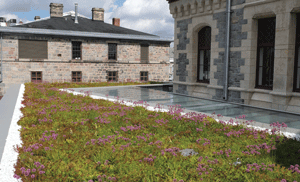 LiveRoof – LiveRoof is the premier pre-vegetated green roof system available across Canada. Regionally grown modules with vegetation specifically selected and tested for your climate by the horticultural professionals at LiveRoof.
 Mitsubishi Electric Sales Canada Inc. – Offering a wide range of solutions for the residential and commercial market including: Air Source VRF, Water Source VRF, Hybrid VRF, Single-Split, Multi-Split, Hydronics and Ventilation.
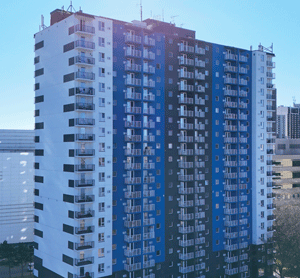 Pretium Engineering – Energy and Carbon Reduction experience, helping clients to not only meet, but exceed their goals. Firsthand knowledge of what it takes to meet even the most stringent energy and carbon goals.
 SaveEnergy NB – SaveEnergy NB has rebate programs and expert advice for NB businesses. From big to small projects, retrofits or new buildings; there’s money to help your business save!
 SHARC Energy – Utilize wastewater for your sustainable heating & cooling projects, from district sized to individual buildings.
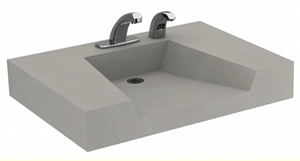 SLOAN Valve – Sloan’s EPDs are produced in accordance with international standards and third-party verified resulting in full LEED Material and Resource credits for your project.
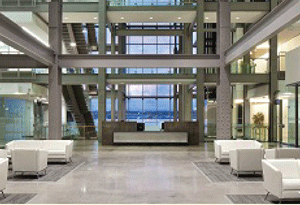 Teritt Indoor Environmental – Indoor air quality testing for LEED and other green building projects over 450 new construction projects since 2010.
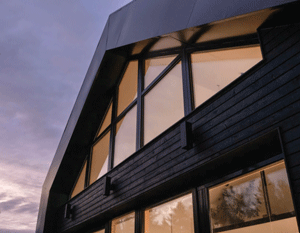 VETTA Windows & Doors – Aluminum clad triple-glazed wood windows and doors; Passive House and FSC certified; German steel hardware; high grade anti-theft and acoustic barrier performance.